
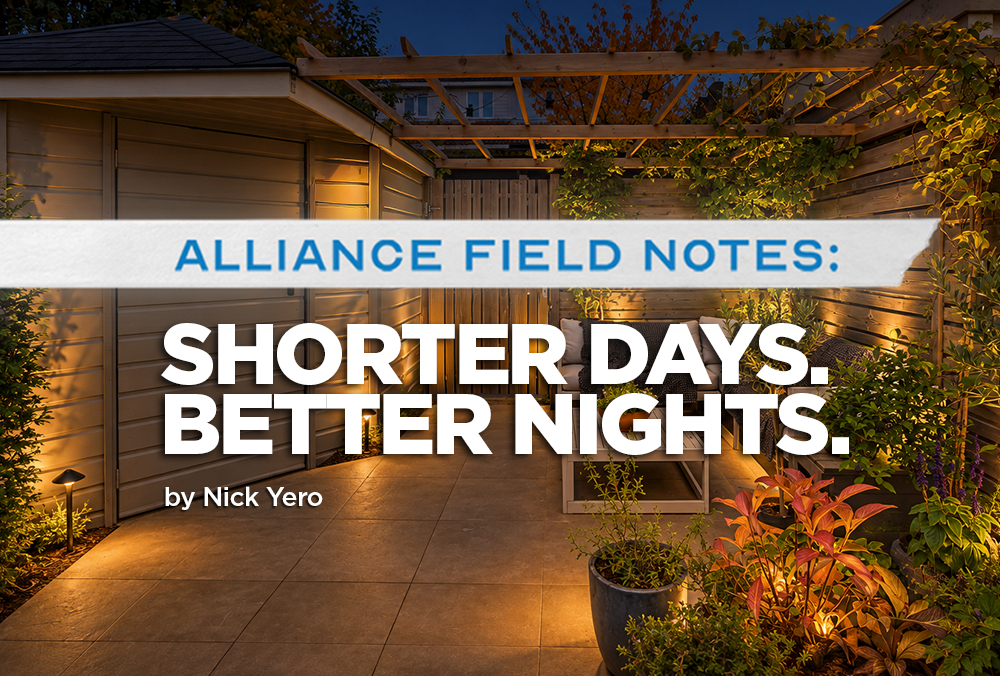

Alliance Field Notes from Nick Yero
Your regional reps, your real-world lighting experts.
As summer heat eases, outdoor spaces come back into regular use. The days are shorter, but cooler evenings give people more reason to spend time outside. Outdoor lighting helps make that happen.
Across Texas, Oklahoma, and Arkansas, that makes fall a good time to look at a property a little differently. Fall landscape lighting starts with how people are actually using the space after sunset, how they move through it, and what the changing landscape gives you to work with.
Here’s what to look for during a fall walkthrough:
1. Where are people actually spending time?
When temperatures ease, outdoor kitchens, patios, grills, bars, and seating areas start earning their keep again.
Look at the spaces people are gathering in first. Then look at the surfaces and structures that can either use light or help you deliver it: counters, steps, walls, posts, and nearby hardscape.
Around an outdoor kitchen or patio, the goal usually isn’t to light everything equally. You want enough light where people need it while keeping the atmosphere comfortable.
Under-cap lighting can define a bar or seating wall. Downlighting can cover a larger gathering area without filling it with visible fixtures. Hardscape lights can handle steps and edges. Mini Lights work well when you need a smaller fixture around tight details or spaces where a standard fixture would be too much.
If you’re looking for ideas in those tighter applications, our Mini Lights guide and Hardscape Lighting guide break down some of the options.
Restraint matters here, too. DarkSky International and the Illuminating Engineering Society recommend targeting light where it’s needed and keeping levels no brighter than necessary. That same principle works well in outdoor living spaces: put the light to work without letting it take over the scene. Five Principles for Responsible Outdoor Lighting
2. How do those spaces connect?
The fire pit might be 40 feet from the patio. The pool might sit beyond the outdoor kitchen. Once it gets dark earlier, those routes matter more.
I don’t just look at the destination. I look at how someone gets there.
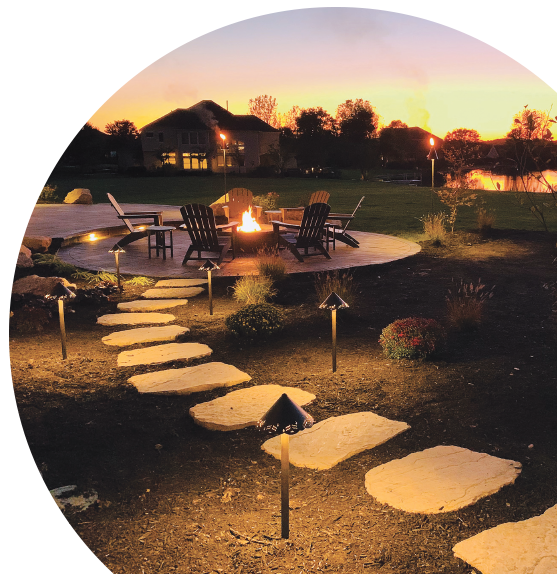
A path from the patio to the fire pit should feel connected to the rest of the property. The same goes for the walk between an outdoor kitchen and pool, a side yard leading to the backyard, or steps connecting different elevations.
Path lights, downlighting, and low-level hardscape lighting can guide people through those transitions without competing with the main gathering space.
For a fire pit or fireplace, I’d let the flame stay the focal point. The surrounding lighting can handle the route in, nearby planting, steps, and edges while the fire does what it’s supposed to do.
Alliance path and area lighting can handle the ground-level route, while tree-mounted downlighting gives you another option when you want softer coverage from above. Our tree-mounted downlighting guide goes deeper into placement, aiming, wiring, and planning for future tree growth.
That connection between spaces is a big part of fall landscape lighting. People may be spending the evening in several parts of the property, and the lighting should help those spaces work together.
3. What does fall reveal that summer hides?
As foliage thins on deciduous trees, trunks, branching patterns, and major limbs can become much more visible. Between leaf drop and spring growth, that branch structure can be easier to read.
That can give you a completely different nighttime canvas.
A mature oak that felt like one big mass of foliage during summer may suddenly show a trunk split, a strong horizontal limb, or a canopy structure worth highlighting. It’s a good opportunity to look again instead of assuming the tree should be lit exactly the same way all year.
For bigger focal points, fixtures like the BL400-BT, WL400-BT, or BL395-LED can give you the output needed for larger trees and deeper landscape features. Closer to patios, walls, and steps, Mini Lights and hardscape fixtures can handle the smaller details.
But fall is only one version of the property.
Fall can reveal structure that summer foliage hides, but you should still be thinking about what that landscape will look like when it fills back in. A good lighting plan should work with the property through the seasons, not just what you see that day.
That means looking at what the landscape gives you now and thinking ahead to spring and summer before you lock in placement and aiming.
Bring lighting into the conversation
If your landscaping customer already has an outdoor kitchen, patio, pool, fire pit, or entertaining area, there’s already a reason to bring up how lighting can help them keep using that space after dark.
The conversation starts with what they’ve already invested in.
Where are they going to eat? Where will people sit? How do they get from the patio to the fire pit? What happens to the trees and landscaping they paid for when the sun goes down?
Those questions give lighting a natural place in the project.
If you want more ideas on introducing lighting without making it feel like a separate sales pitch, Gerri Murray covers that in Alliance Field Notes: How to Sell Lighting Jobs.

Nick Yero is the regional sales rep for the North Texas, OK and AK area. He has a background in landscape and irrigation contracting, with residential and commercial experience.
 Use this form to sign up for our newsletter. If you need technical support, please contact our